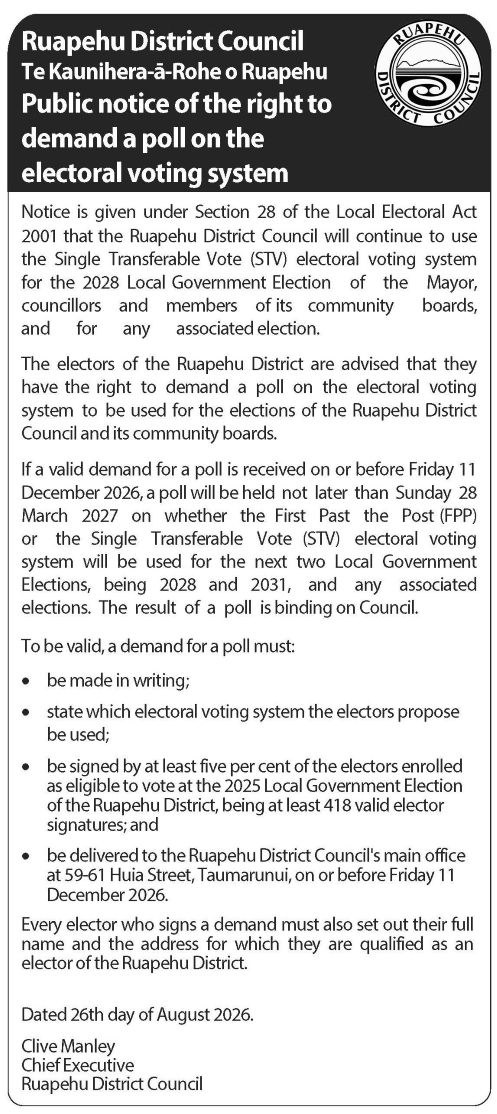
What system will be used
Council decided in August 2023 to keep the Single Transferable Vote system for both the 2025 and the 2028 elections. Nobody asked for a poll at the time, so that decision stands. Single Transferable Vote has been used in Ruapehu since 2019.
Council is not proposing to change the system. We are letting you know because the law requires us to tell you about your right to ask for a poll, whether or not anything is changing.
How Single Transferable Vote works
You rank the candidates in the order you prefer them. Write 1 beside your favourite, 2 beside your next favourite, and so on. You can rank as many or as few candidates as you like.
To be elected, a candidate needs to reach a set share of the votes. If your first choice has more votes than they need, or is not going to be elected, your vote moves to your next choice instead. This keeps happening until all the positions are filled.
The main advantage is that fewer votes go to waste. Even if your first choice misses out, your later choices still count. The main disadvantage is that the counting is more complicated and takes longer, and a computer does it rather than a person.
If you would like to see how a Single Transferable Vote count actually works, our election provider has a short online demonstration you can try: www.electionz.com/STV5
How First Past the Post works
You tick the candidates you want. If there are five positions to fill, you can tick up to five names. The candidates with the most ticks win.
The main advantage is that it is simple and quick to count. The main disadvantage is that it does not always reflect the range of views across a community. A candidate can win without most voters having chosen them, and if several similar candidates split the same group of support, that group can end up with nobody elected.